
The Power of AI in Generating Campaign Visuals
Something quiet but profound is shifting in marketing. Not the big campaign announcement. Not a new tool everyone embraces simultaneously. But the reality that entrepreneurs working with AI image generation today will simply have better content next week than those who don't. And in twelve months, the gap will be vast.
The question is no longer whether AI can create images. We passed that step long ago. The question is what this fundamentally changes for the position of the entrepreneur who does or manages their own marketing.
What has shifted in the past two years
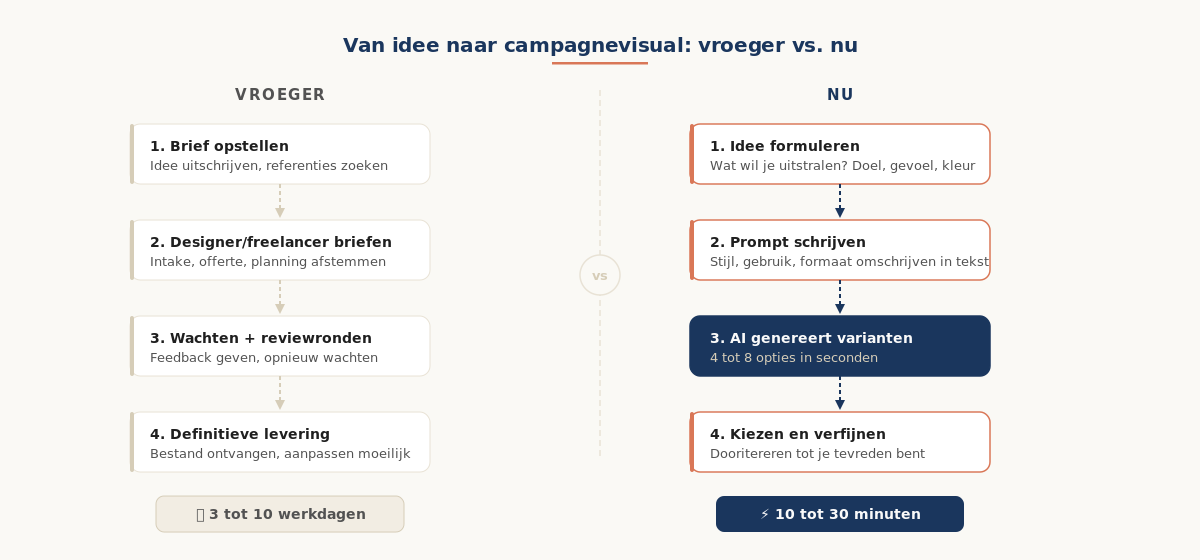
Until a few years ago, image production for marketing was a specialized field. You needed a photographer for product or lifestyle photos, a graphic designer for campaign materials, and a stock photo subscription for the rest. Together, this amounted to a few thousand euros per quarter if you took it seriously, or disappointing results if you cut corners.
AI image generation did exist but produced something you immediately recognized as AI. Hands with six fingers. Nonsensical text. An atmosphere that never quite felt right.
That's over. The models of 2026 render text correctly, maintain character and product consistency across multiple images, and understand composition at a level difficult to achieve without reference images. The barrier between 'AI image' and 'usable campaign visual' has largely disappeared for a significant part of standard marketing production.
What this means for you as an entrepreneur
It's tempting to see this as a cost-saving tool. Less budget for stock photos, fewer freelancers. That's true. But the bigger change isn't on the cost side.
AI image generation shifts the production phase from days to minutes. And that changes how you can think about marketing.
If you wanted to test a new ad, you used to have to decide which visual to create, because you could only afford one or two. Now you test eight variants simultaneously. The outcome of that test teaches you more about your target audience than any agency report.
If you respond to news, a trend, or a moment in your industry, there's no longer a week between the idea and the visual that expresses it. You can put it online an hour later.
If you launch new services or product lines, you have visuals before you've even had one physical sample made.
This isn't doing the same things faster. This is thinking differently about what you're trying to achieve in the first place.
Where AI is strong, and where the limit lies
Not everything shifts equally fast. Here's an honest picture of where AI stands now:
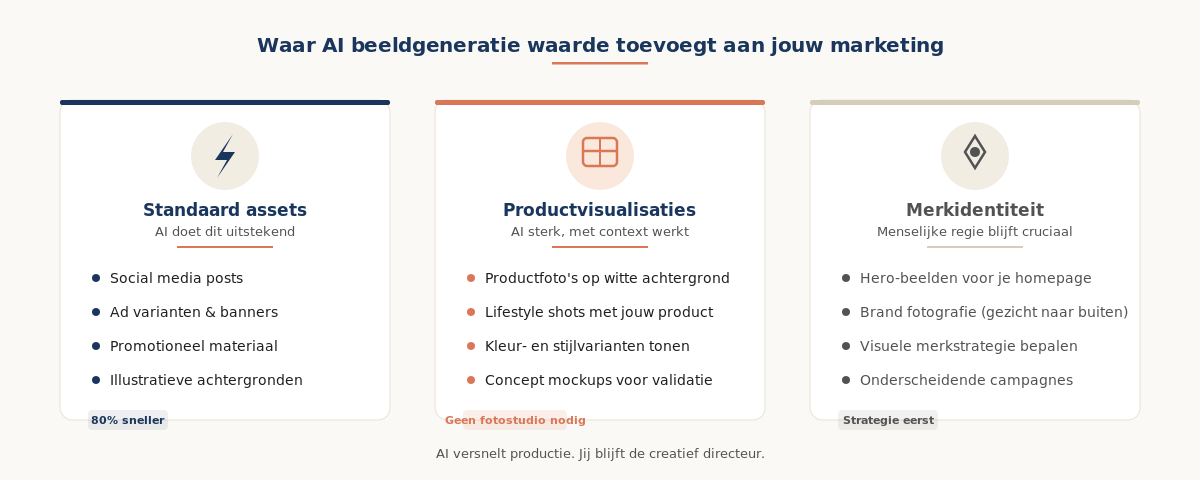
For standard marketing assets, AI is now dominant. Social posts, ad variants, banners, illustrative backgrounds: these are products for which you don't need a professional photographer or designer, unless you want a special creative direction. For product photos on a white background, lifestyle shots and color variations, AI works strongly, as long as you describe the product well or upload it as a reference.
Brand identity is another story. The decision of what your company visually looks like, what atmosphere you convey, what the hero images on your homepage communicate—that's not a production task. That's strategy. AI can help with execution, but the direction must come from you. And for your very best images, the photos with which you really want to stand out, a professional photographer is still the better choice.
The practical distribution I see among entrepreneurs who do this well: the first 80% of their image production is AI, the 20% that truly defines their brand remains human work.
The skill that matters now
There is one competence that determines how well you benefit from AI image generation: providing creative direction through text.
That sounds simple. It is simple at its core, but it requires practice. Entrepreneurs who get good results quickly learn to describe what they want in a way a human photographer would understand. Style. Light. Composition. Use. Feeling. Not in technical jargon, but in plain language.
'A product photo of my mug in a morning-lit kitchen, soft shadows, rustic wooden table, warm atmosphere' yields better results than 'studio lighting bokeh effect 50mm'. The model translates the former better into what you mean.
The second layer is iteration. A first prompt rarely gives the perfect image. The value lies in iterating: 'same image but warmer', 'more space to the left for text', 'different color for the product'. Treat it like a briefing to a creative, not a search query.
What the strategic consequence is
The production costs of marketing content are falling to almost zero for much of what entrepreneurs need daily. That sounds like good news, and it is. But it has a less obvious consequence.
If everyone has access to unlimited production, then production is no longer the differentiator. The differentiator shifts to creative direction, brand strategy, and the insight to know what image you want to create.
Technically, AI democratizes. But strategically, it amplifies the advantage of the entrepreneur who clearly knows what they want to convey. The one who doesn't have that clarity will now simply create content faster that fails to resonate with anyone.
So the question isn't just 'how do I use AI to create images'. The question is 'what do I want my brand to communicate, and how do I use AI to execute that consistently?' That second question is the more interesting one.
Do you want to get started with this concretely, for your industry and your visual language? That's precisely what High Performing Company helps with. Schedule a call and we'll look together at where the biggest leverage lies for you.