
ChatGPT Now Talks Back While You Speak: How GPT-Live Transforms Your Business
On July 8, OpenAI launched GPT-Live, a new generation of speech models replacing the old Advanced Voice Mode in ChatGPT. The headline in most articles is that it sounds more natural. While true, that's not the interesting part. The interesting part is that the way you interact with AI is fundamentally changing, opening doors that were closed until last week.
More than 150 million people already use voice to speak with ChatGPT. The question isn't whether you will too. The question is for which tasks in your company this will become worthwhile.
What's Technically Different
In the old voice mode, you had to wait for your turn. You speak, the model waits until you finish, converts your words to text, devises a response, converts that back to speech, and only then do you hear something. Three models take turns handing off the baton. Hence those awkward silences and the feeling of talking into a walkie-talkie: over, and wait.
GPT-Live is full-duplex. This means the model can listen and speak simultaneously, just like a human in a real conversation. You can interrupt it. It can hum in affirmation while you're still explaining. It can remain silent for half a minute while you think, then jump in at precisely the right moment. The difference from before is like the difference between a walkie-talkie and a phone call.
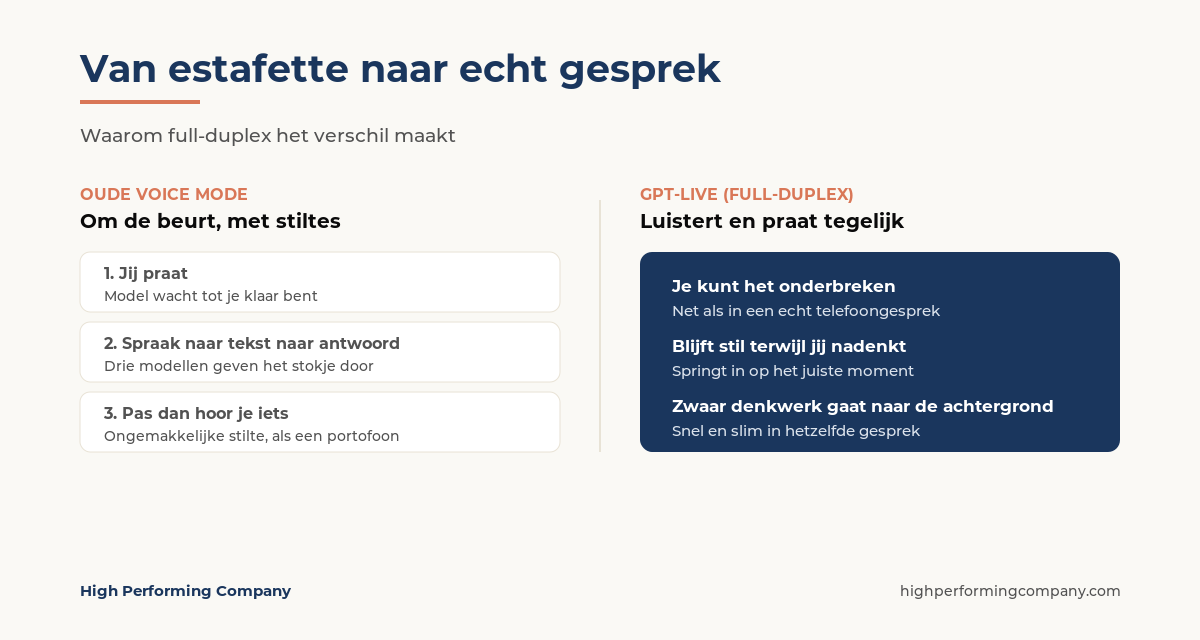
The second change is under the hood. GPT-Live conducts the conversation, but as soon as you ask something that requires real thought or a search query, it passes that question to a heavier model in the background and brings the answer back into the conversation as soon as it's ready. You'll barely notice, except that you no longer have to choose between fast but dumb and smart but slow. You get both in the same conversation.
And then there's live translation. Because the model simultaneously listens and speaks, it can translate your words while you're still talking. Not perfectly, more on that in a moment, but the principle works.
Where I See the Business Use Cases
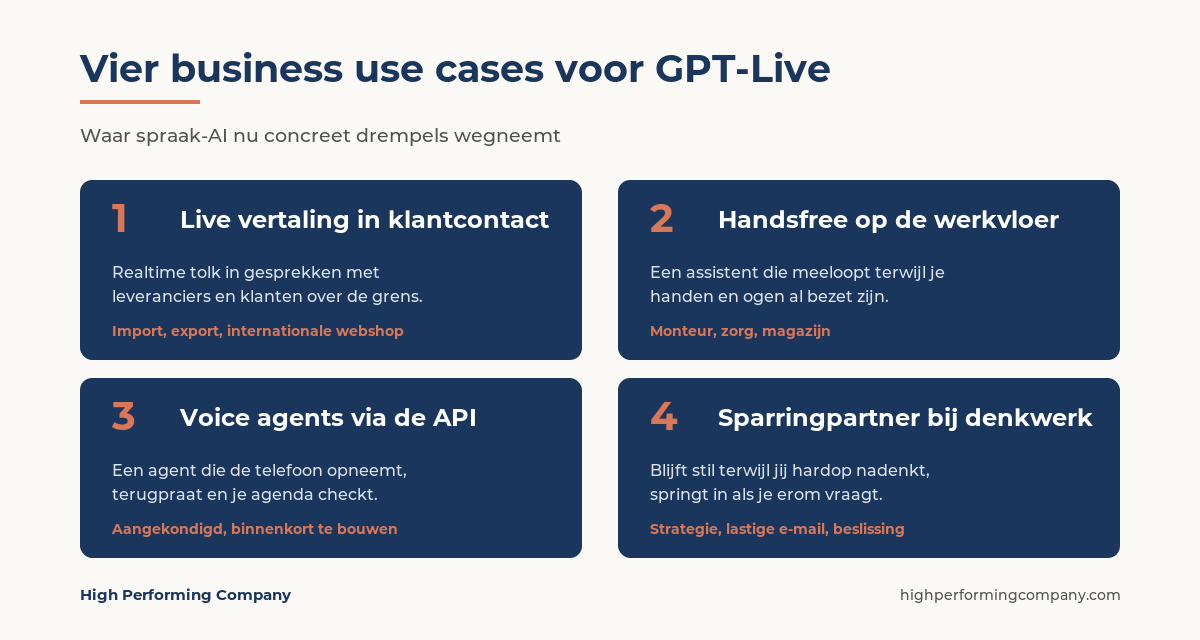
The reflex with these types of launches is that it's a fun toy. I prefer to look at where it concretely saves hours or removes barriers. Four areas stand out.
Live translation in customer contact. If you do business across borders, with suppliers in Asia or customers in Germany, language is often the inhibitor. A conversation where you speak Dutch and your conversation partner hears it in their own language, in real-time, removes a barrier that previously required an interpreter or cumbersome English. For an importer, an exporting webshop, or a service provider with international customers, this offers immediate value.
Hands-free work on the floor. Not everyone sits at a desk. A technician with their hands in a machine, a nurse on rounds, someone in a warehouse. An assistant you can have accompany you for 30 to 40 minutes, who you interrupt and ask something without picking up your phone, fits work where your hands and eyes are already occupied. OpenAI's product lead reportedly has half-hour conversations while walking. Translate that to your workplace.
Voice agents via the API. This is the use case I'm most looking forward to, and one most people miss. OpenAI has announced that GPT-Live will soon come to the API. At that point, you can build this technology into your own phone line, your customer service, or your appointment system. An agent that answers the phone, responds naturally, handles interruptions, and checks your schedule or inventory behind the scenes. The leap from chatbot on the website to someone answering the phone is precisely what full-duplex makes possible. This is where it gets interesting with AI Agents.
Sparring partner during thought processes. Less visible, but valuable. An assistant who can remain silent while you think aloud, and only interjects when asked, transforms from a search engine into a conversation partner. For strategic work, a difficult email, or dissecting a decision, this is a different kind of help than typing in a chat window.
The Sober Caveat
But everything doesn't work perfectly yet. In OpenAI's own demo, the live translation to Hindi sounded clunky and with a heavy American accent. "Optimized for most spoken languages" isn't a promise that it will work flawlessly in your language and your jargon. Test it on your own use case before deploying it for a customer.
Two things to keep in mind. One: the voice agents via the API have been announced, not yet rolled out. Those who want to build on this should plan now and build later. Two: OpenAI explicitly emphasizes that this is not an AI friend or companion robot. That's a legitimate boundary, and for business use, it's exactly right. You want a tool that does work, not an assistant your employees chat with all day.
What This Means for You
The greatest shift isn't the voice quality. It's that speech is transforming from a gimmick into a serious interface for work. OpenAI even sees voice as the future way for AI to perform complex, long-running tasks. Whether that fully materializes, no one knows, but the direction is clear.
For you as an entrepreneur, the practical question is simple: where in your company is work currently stalled by language, occupied hands, or a phone that no one can answer? That's your first experiment. Start small, test it on a process, and see if it delivers what the demo promises.
Do you want to find out where speech AI and agents truly have leverage in your processes, instead of gambling on the next hype? That's precisely what High Performing Company helps with. Schedule a conversation and we'll jointly explore where your biggest gains lie.