
Vibe coding versus agentic coding: why the difference determines how you build your business
Two years ago, you had to hire a developer to build a simple internal tool. Today, you type a sentence into Lovable and a working dashboard appears. Or you give Claude Code a task and an hour later a finished feature, tested and ready, awaits.
These seem like two versions of the same story: AI now builds software. But under the hood, they are two fundamentally different ways of working. And the difference between them will determine more about how you run your business than which tool you happen to choose.
In this piece: what vibe coding and agentic coding are precisely, why Lovable and Claude Code are on opposite sides of the same spectrum, and what that means for entrepreneurs who want to get serious with AI now.
Vibe coding: you stay in control
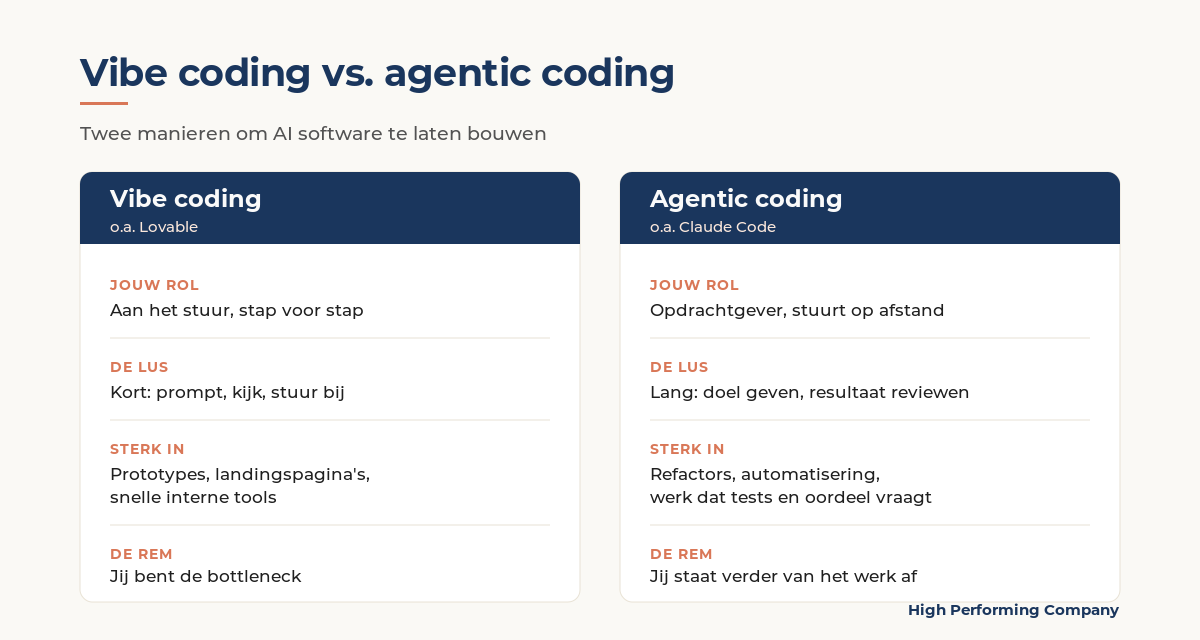
Vibe coding is building by talking. You describe what you want in plain language, the AI creates it, you review it, you refine it, and you repeat until it's right. Lovable is the best-known example of this. You open a chat window, type "create a booking system for my hair salon with a calendar and email confirmation," and you see the thing emerge before your eyes. Frontend, database, login function, payments: all from a conversation.
The power lies in the short loop. You see results immediately, you click on elements to adjust them, and you don't need to understand a line of code. This makes it ideal for prototypes, landing pages, and internal tools you want to test quickly. Since April 2026, Lovable even runs directly on your phone, so you can flesh out an idea while on the train.
The downside is that you remain the bottleneck. Every step waits for your input. Work progresses only as fast as you can prompt, review, and adjust. For small tasks, this is perfect. For something large, it quickly becomes a long series of conversations where you have to confirm every decision.
Agentic coding: you hand over the reins
Agentic coding reverses the relationship. Instead of guiding step by step, you set a goal and let an agent work it out autonomously. Claude Code is the prime example here. You say "refactor the entire payment module and update the documentation," and the agent creates a plan, executes it, tests it, fixes its own errors, and delivers the result.
The difference from vibe coding is not how smart the AI is. The difference is how much you delegate. With Lovable, you keep your hand on every decision. With Claude Code, you hand over the task and the judgment of its execution, and you assess retrospectively whether the result is satisfactory.
That makes agentic coding suitable for heavier work: refactors across multiple files, tasks that require multiple steps and testing rounds, work where consistency and control are more important than iteration speed. It's no longer autocomplete or a conversation. It's outsourcing work to something that operates independently.
The same spectrum, two extremes
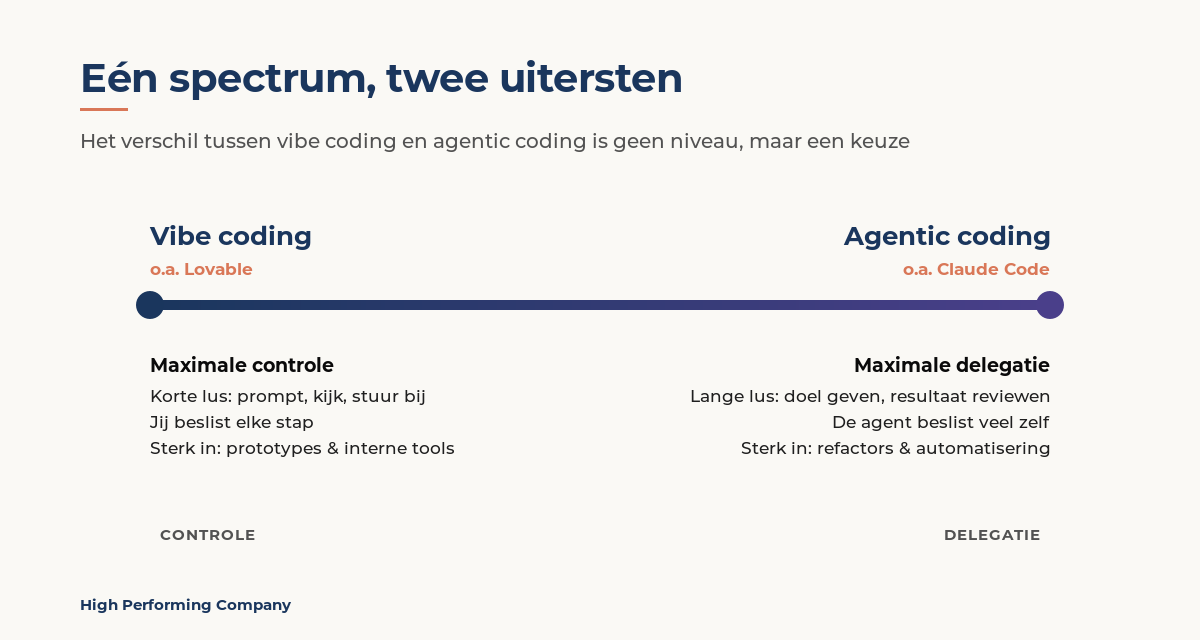
It's tempting to frame this as "easy versus difficult" or "for beginners versus for developers." That's not accurate. The true distinction is control versus delegation.
At one end of the spectrum is vibe coding: maximum control, short loop, you decide everything, but you are also the stopper. At the other end is agentic coding: maximum delegation, long loop, the agent makes many decisions independently, but you are further removed from the work and must learn to review effectively.
A simple rule of thumb: choose vibe coding if you want to stay close and adapt quickly to something small. Choose agentic coding if you want to outsource work that is too large or too cumbersome to guide step-by-step yourself.
In practice, serious users employ both. Lovable to quickly test an idea or assemble an internal tool. Claude Code for work that requires structure, tests, and judgment. They are not competitors; they are two settings on the same dial.
Where the real shift lies
The question "which tool should I choose" distracts from what truly matters. Because both of these ways of working show the same underlying shift: the execution of software is increasingly detached from human involvement.
In 2024, the person doing the work was the bottleneck. In 2026, AI can produce more than you can oversee. This shifts where your value lies. No longer in the making itself, but in determining what needs to be made, formulating a clear brief, and assessing whether the result is correct.
This strongly resembles something entrepreneurs already know: working with a good freelancer or an executive team. You don't win by working harder yourself. You win by giving better briefings and reviewing faster. Vibe coding teaches you this with a short loop and immediate feedback. Agentic coding forces you into the role of a client remotely guiding. Both train the same skill: maintaining control without being the executor yourself.
Entrepreneurs who are embracing this now are building internal tools and automations at a pace that was only possible a year ago with an entire development team. Not because they have become better at programming, but because they have become better at delegating.
What this means for your business
Don't start with the tool, start with the task. If you want to quickly test something, create a prototype, or a simple internal tool, vibe coding with Lovable is an excellent first step you can take yourself today. If you want true automation or a serious application that needs to run in your business, you will sooner or later enter agentic coding territory, where judgment and control make the difference.
The gain is not in choosing the right tool. It is in developing the right reflex: knowing when to stay close and when to let go of the work. That is precisely what entrepreneurs are inherently better at than any tool.
Do you want to know which setting on that dial fits your business, and how to implement this practically without becoming a developer? Schedule a consultation and we'll jointly explore where the greatest leverage lies for you.
Sources
- My Honest Lovable Vibe Coding Review (2026)
- Lovable launches its vibe-coding app on iOS and Android - TechCrunch
- Vibe Coding vs. Agentic Coding: Which One Actually Ships?
- Agentic Coding vs. Vibe Coding: Key Differences Explained
- Vibe Coding vs. Agentic Coding: Fundamentals and Practical Implications (arXiv)