
Which Jobs Are Safe From AI?
Most articles about AI and work fall into two camps. Either it's panic — "AI will take over your job." Or it's dismissal — "it won't be so bad." Neither is true.
Anthropic recently published their Economic Index: an analysis of millions of actual Claude conversations, combined with data on task profiles per professional group. This provides, for the first time, a factual picture of where AI is truly having an impact, and where it is not yet.
1. A Large Group of Jobs Remains Untouched
Work that involves physical activity (repairing a roof, caring for a patient, driving a truck) will not be replaced by a language model. Not tomorrow, and not meaningfully in ten years.
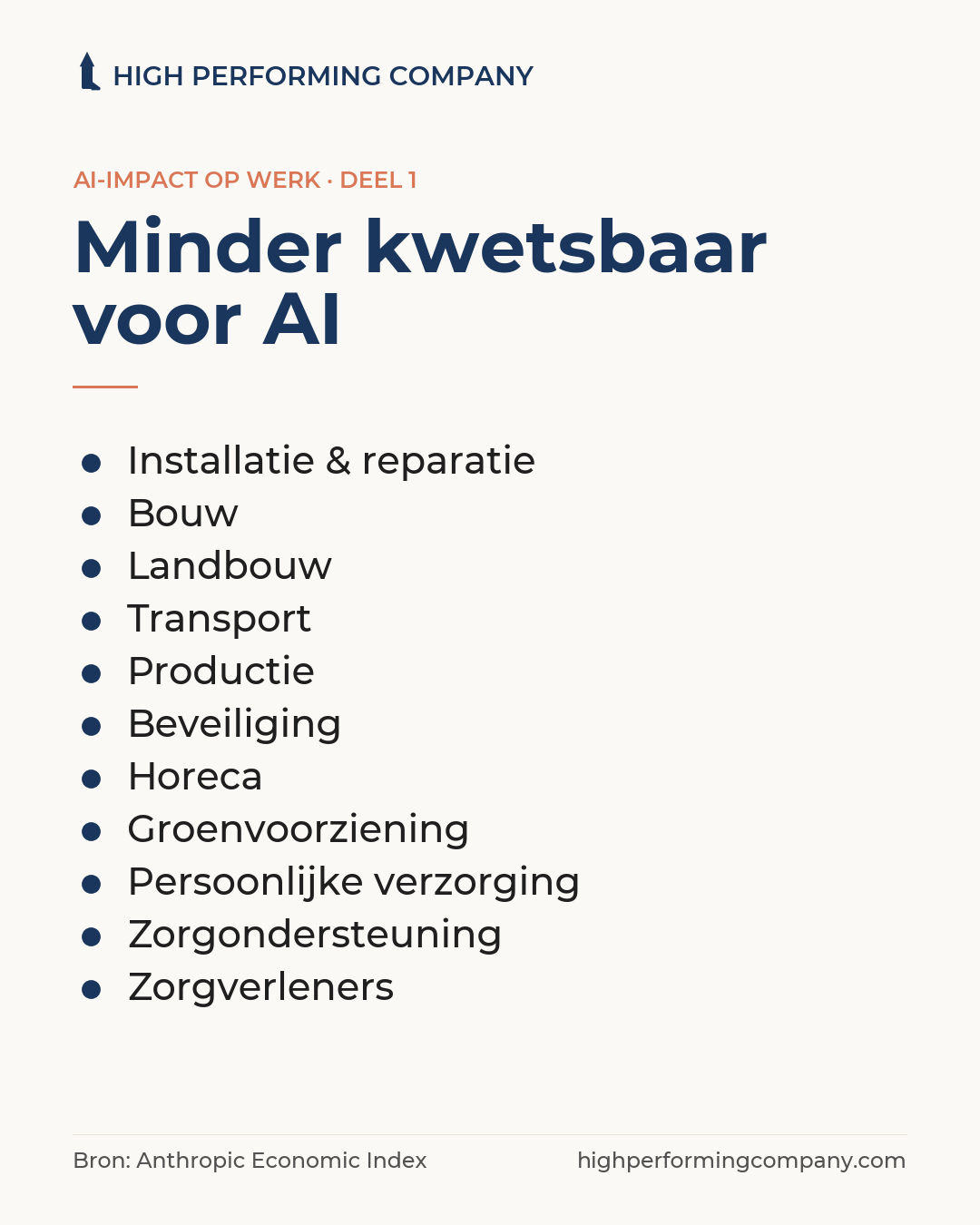
This accounts for a significant portion of the Dutch economy: construction, healthcare, logistics, hospitality, installation. Tens of percentage points of employment.
For entrepreneurs in these sectors: the narrative "AI will take over our work" is not your narrative. AI will affect your administration, planning, customer contact, and marketing, but your core operations will remain human work.
2. Office and Knowledge Work Is Exposed
On the other side of the spectrum: management, finance, legal, sales, office, and administration. Everything that runs on text, rules, and patterns.
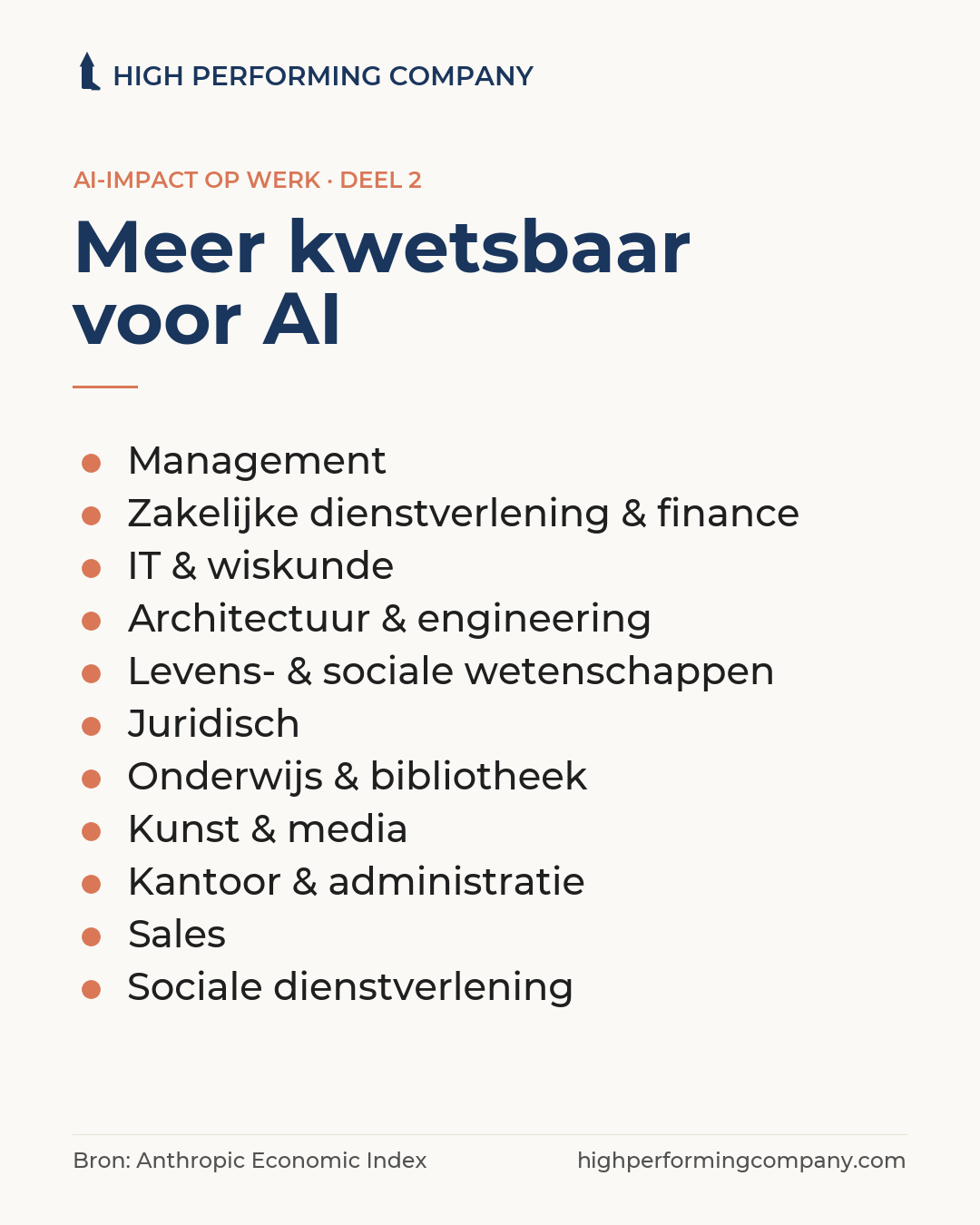
Important: this is about tasks, not entire jobs. A management role consists of a hundred things, and AI can do perhaps thirty of them. That's not job loss; that's a productivity leap.
The question is not "will this position be abolished." The question is "which 30% of the work in this position can soon be done in a tenth of the time."
3. And Now the Interesting Part: What AI Can Do Versus What Companies Are Doing
This is the graph that really matters.
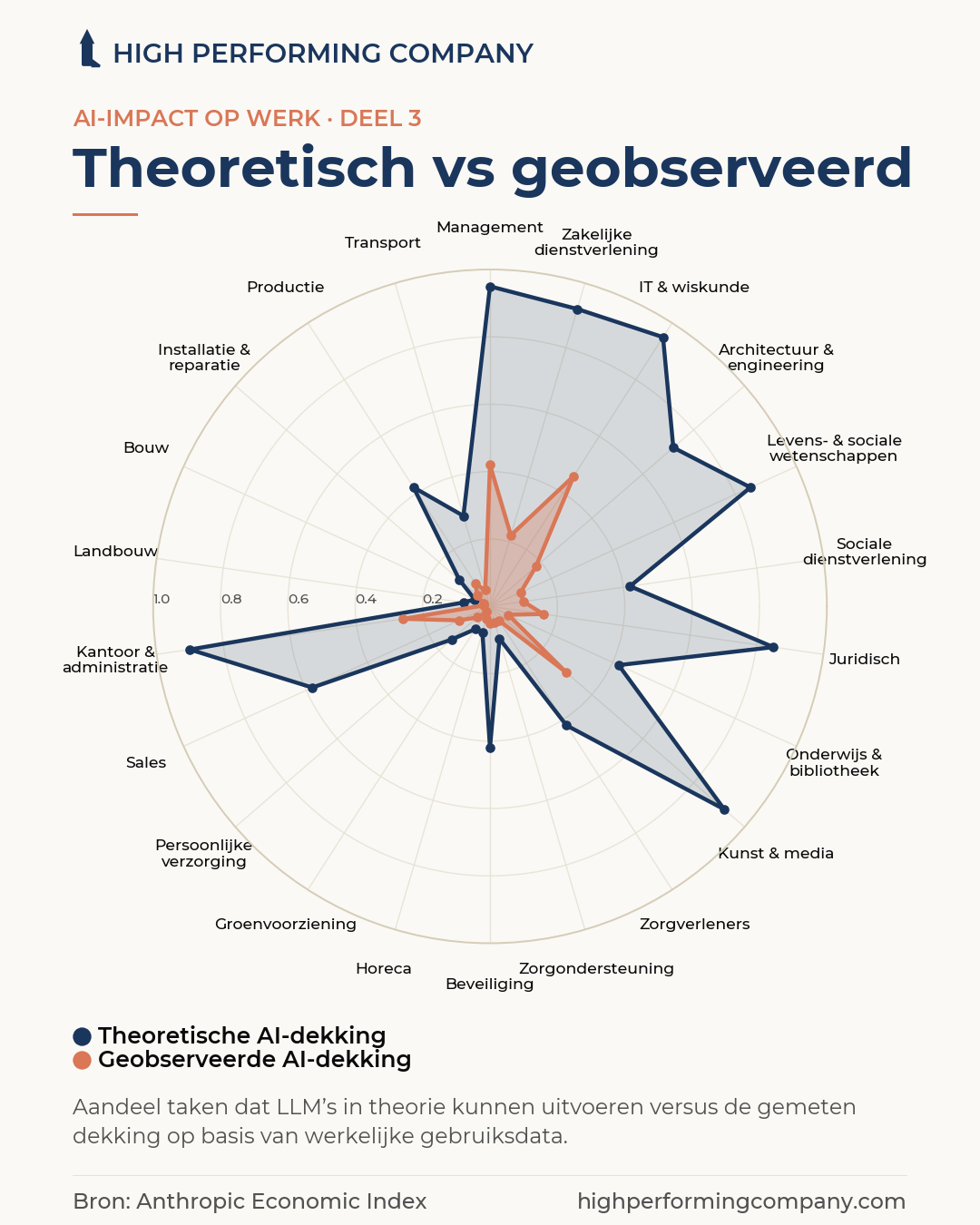
Dark blue: what AI can theoretically do, per occupational category. Terracotta: what actually happens in practice, measured based on real Claude usage.
Look at the difference.
For management, legal, art & media: theoretically, AI can handle 80 to 95% of tasks. In practice, it is used for only 10 to 30% of those tasks. For office and administration, the picture is the same: high theoretical coverage, low actual adoption.
Technology is far ahead of the organization.
What Does This Mean if You Run a Business?
Three things.
- The adoption gap is your opportunity, not your risk. If your competitors "aren't doing anything with AI yet," it doesn't mean it can't be done. It means they don't know it yet or aren't pushing through. The terracotta versus dark blue gap in that last graph? That's their lag. And your head start if you seize it.
- Start with tasks, not jobs. No one will be replaced by a chatbot. But within every role in your company, there's a set of tasks that currently takes two hours a day and could soon take twenty minutes. Find those tasks; that's where the profit lies.
- Office work is your first stop. If you run an SMB with people in administration, finance, sales, or marketing, that's where your first 30-50% efficiency gain is. Not with your technicians or healthcare workers. The graph shows you the way.
At High Performing Company, we help entrepreneurs concretely close that gap. Usually in days, not weeks. Want to know where the first profit lies in your company? Send me a message.
Source: Anthropic Economic Index