
Evolution and revolution: why frontrunners run two AI tracks at once
For my new book on vibe coding and AI coding I speak with entrepreneurs who lead on AI. One pattern stands out. The frontrunners run two tracks at once: they make their existing processes smarter with AI, and they rebuild the heart of their organisation with AI coding. Evolution and revolution, side by side.
Most companies pick the first track only. Understandable, since it delivers quick results at limited risk. The frontrunners spot something extra: a smarter process on top of ageing software hits a ceiling.
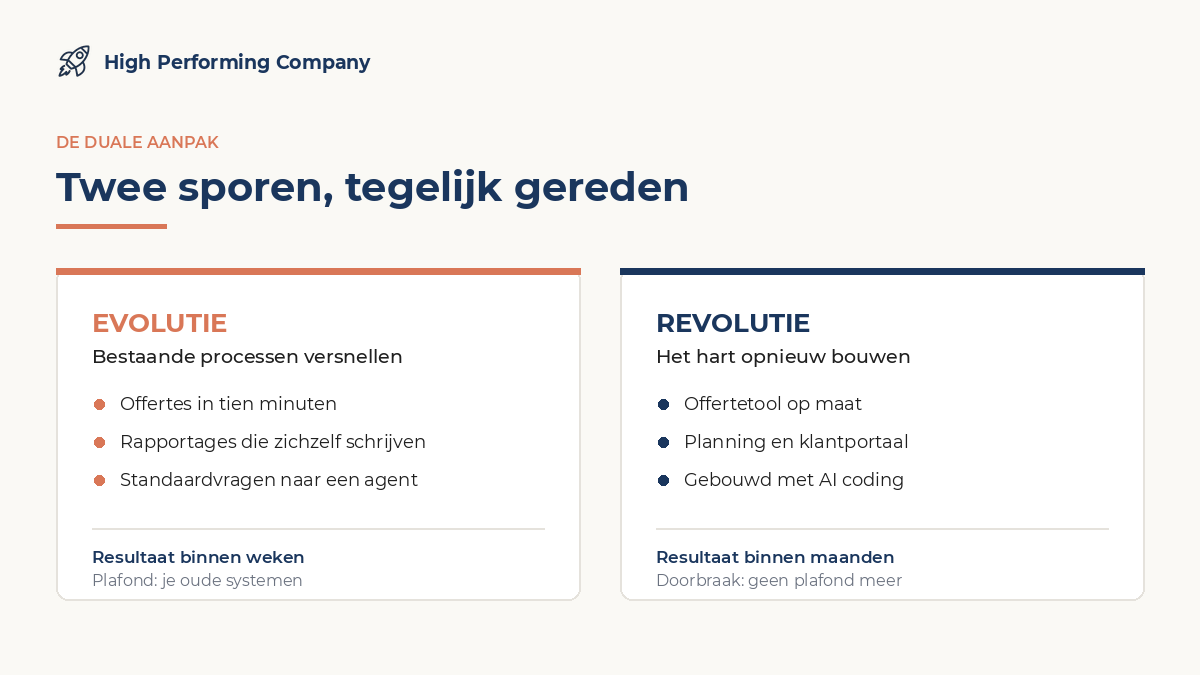
Track 1: evolution
Evolution accelerates your current way of working. Quotes in ten minutes instead of an hour. Reports that write themselves. Standard questions handled by an agent. Your organisation stays as it stands, the pace doubles.
This track pays off immediately. Your team feels the difference within weeks, support grows and you build AI skills in practice. Almost every entrepreneur starts here, and rightly so.
The ceiling appears the moment your process stalls on your systems. An AI agent pulling data from a 2014 package through manual exports stays a patch on a deeper problem.
Track 2: revolution
Revolution redesigns the beating heart of your business: your quoting tool, your planning, your customer portal, your internal dashboard. Custom software, built with AI coding, in weeks instead of years.
Five years ago that asked for a team of developers and a budget with six zeros. Today a small group builds a working system with Claude Code, Lovable or Codex in a few sprints. Anthropic reports that Claude wrote over 80 percent of its own production code in May 2026. That acceleration now reaches smaller companies too.
Why the combination makes the difference
McKinsey researched what AI leaders do differently. Among high performers, 55 percent fundamentally redesigned workflows while deploying AI, against roughly 20 percent of the rest. Workflow redesign has the largest effect on visible impact in the profit and loss account.
MIT shows the same coin from the other side. Around 95 percent of corporate AI pilots deliver zero measurable return. The cause sits rarely with the model. The cause sits with systems and processes that carry the new work poorly.
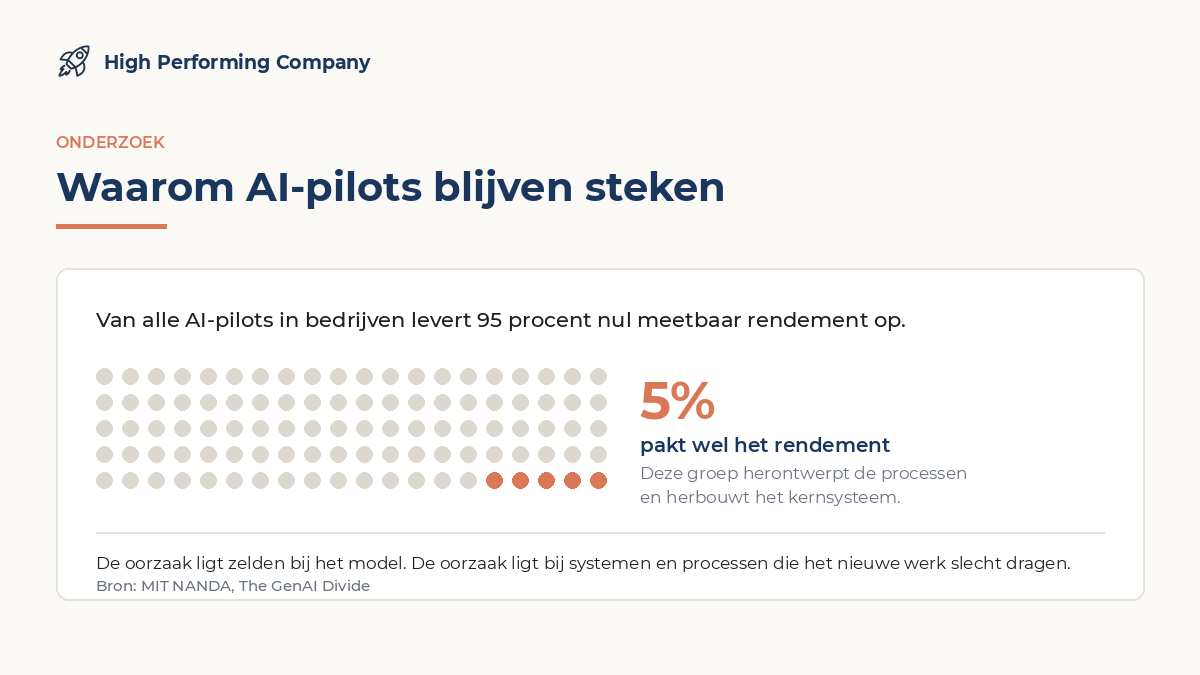
Read those two figures together and a sharp picture appears. Optimising alone keeps you inside the 95 percent. Rebuilding alone costs you the quick wins and your team support. The combination places you among the 5 percent that captures the return.
How to run both tracks at once
Four concrete steps:
- Split your attention deliberately. Reserve roughly 80 percent of your AI budget for evolution and 20 percent for revolution. The first track funds the second.
- Pick one core system. Take the system where your people lose the most time. Start rebuilding there, in a separate environment next to production.
- Build in weeks, test with real users. AI coding delivers a working prototype within days. Let your team use it, gather reactions, build again. That cycle replaces the classic functional design document.
- Keep the old one running until the new one wins. Run both systems side by side. As soon as the new system beats the old one on speed and ease of use, you switch over.
The common thread
Waiting feels safe and costs the most. Every month on an ageing core system shrinks the gain AI delivers in your processes. The entrepreneurs I speak with for my book share one attitude: they accept that their most important software looks different three years from now, and they start building today.
Bold? Certainly. In my view also the only route that holds up.
Curious which track delivers most for your organisation? In the AI strategy and awareness workshop we map it out concretely in half a day.